Why strength and progressive loading matter for healthy bones as we age. Getting older doesn't have to mean asking less of your body.
Bone likes a reason to adapt
When we walk, run, jump, lift or perform resistance exercise, forces travel through our muscles and skeleton.
Bone can respond to those mechanical demands. This is one reason appropriately prescribed resistance and weight-bearing exercise can play an important role in maintaining bone health as we age.
But the answer isn't simply to tell everybody to 'lift heavy'.
The right starting point depends on the person in front of us — their current strength, experience, health, confidence, injury history and, where relevant, their bone density and fracture risk.
Progressive loading means starting where you are and gradually building what your body can tolerate.
Muscle is part of the bone-health story
Bone health isn't only about bone. The muscles around our skeleton matter too.
Maintaining strength and muscle mass helps us produce and control force, climb stairs, carry things, get up from the floor and respond when we lose our balance. That becomes increasingly valuable as we get older.
Resistance training therefore gives us a useful double benefit: we can challenge the skeleton while also building the muscular strength needed to support physical capacity.
And fracture risk isn't determined by bone density alone. A strong skeleton is valuable. So is having the strength, balance and confidence to reduce your chances of falling in the first place.
Healthy ageing needs more than walking
Walking is excellent. It gets us outside, supports cardiovascular health, keeps us active and, for many people, is one of the most sustainable forms of exercise imaginable.
Keep walking.
But walking and strength training don't do exactly the same job. If we want to maintain muscle, develop strength and provide meaningful loading to different parts of the skeleton, we may need to ask more of the body than our usual daily walk provides.
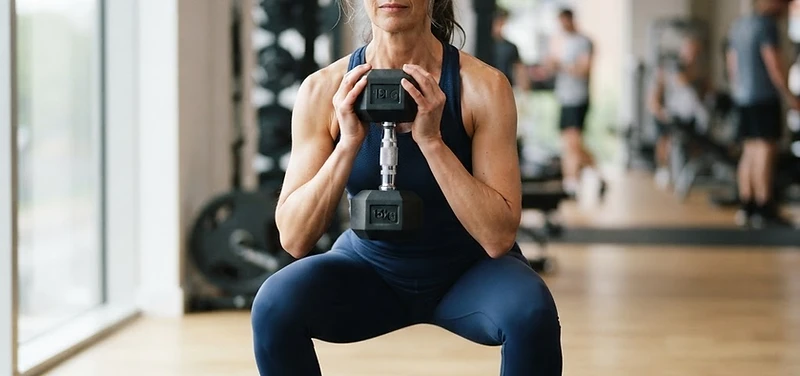
That might mean resistance training with machines, free weights, kettlebells, bands or body weight. Depending on the individual, it may also include appropriately progressed impact exercise.
The important word is progressed.
You don't need to walk into a gym for the first time at 55 and start lifting like someone who has trained for twenty years. You need an appropriate starting point — and somewhere useful to go from there.
Midlife isn't the beginning of the wind-down
There is something about reaching our forties, fifties and sixties that can quietly change the language around exercise. We start hearing about what we shouldn't do.
Don't lift that. Mind your back. Protect your knees. Take it easy.
Sometimes those warnings are appropriate. But if caution becomes our entire strategy, we risk gradually removing the very physical challenges that help us retain capacity.
Midlife should not automatically mark the beginning of physical retreat.
It can instead be an opportunity to invest in what comes next: strength, bone health, balance, cardiovascular fitness and confidence.
Not because we're trying to pretend we're 25. Because we'd quite like to enjoy being 65, 75 and 85.
What if you already have osteopenia or osteoporosis?
A diagnosis of low bone density does not automatically mean that strength training is off the table. Most people with osteoporosis can remain active and exercise safely, but the right programme depends on the individual.
Fracture history, bone health, other medical conditions, current ability and previous training experience all matter. For some people, the first challenge may be learning fundamental movements and developing confidence. For others, appropriately supervised progressive resistance training can become considerably more demanding.
The goal is not to avoid load. It is to find the right load, at the right time, for the right person.
Exercise is one part of bone health. Where osteoporosis medication or other medical treatment has been recommended, exercise should complement appropriate medical care rather than replace it.
Start building your future reserve
You don't need to become a weightlifter. You don't need to love gyms. And you certainly don't need to wait until somebody tells you that your bones have become fragile before deciding that strength matters.
Start where you are. Learn to squat, push, pull, hinge, carry and lift with confidence. Build strength gradually. Keep walking. Challenge your balance. Support your training with good nutrition and recovery, and seek individual guidance where your health or bone density means you need it.
The numbers on a scan matter. But so does what your body can actually do.
Can you carry the shopping? Get yourself off the floor? Lift your grandchild? Walk confidently on uneven ground? Garden for an afternoon? Put your suitcase into the overhead locker and head somewhere interesting?
Those aren't gym goals. They're life goals.
And perhaps that's the most useful way to think about strength and bone health as we age. We aren't training simply to lift heavier weights.
We're building physical reserve for the decades still to come.
Explore how Titan can help.
If this resonates with something you're dealing with, these services at Titan are a natural next step.
WRITTEN BY
David Gow
Chartered Physiotherapist | Founder, Titan Physio